
On 16 April 2026, members of ARCLIB, plus guests from ARLIS, visited two materials highlights in London: Performance Without Toxicity at Fabrica X, and the Materials & Products Collection at Central Saint Martins (CSM), University of the Arts London.
Performance Without Toxicity at Fabrica X
The visit began at Fabrica X, the London innovation gallery of The Mills Fabrica. We were welcomed by co-curator Viktoria Espelund, who gave a really interesting introduction to the organisation and the exhibition.
The Mills Fabrica: background and mission
The Mills Fabrica is a solutions platform focused on sustainability in the interconnected fields of ‘agrifood’ and ‘techstyle’. Agrifood refers to the full food production chain, and techstyle is a portmanteau of technology and lifestyle. These two sectors produce nearly half of global greenhouse gas emissions, alongside other issues such as chemical pollution.
The Mills Fabrica originates from the Nan Fung Group’s historic textile mills in Hong Kong. When manufacturing ceased, the site was redeveloped as ‘The Mills’, a hub for heritage, retail, and innovation. Fabrica is the innovation arm of The Mills, investing in and supporting start-ups working on sustainable solutions in agrifood and techstyle.
Fabrica X
The Mills Fabrica expanded internationally to Cottam House, London in 2021, including establishing their exhibition space, Fabrica X. Performance Without Toxicity is their sixth exhibition.

Initially, the exhibitions had primarily industry audience, but over time, interest from the general public has increased. Building improvements have helped with this, such as adding a door opening onto the street, clearer signage outside, and work on the windows, making it easier for passers-by to view the space. A coffee shop provides a welcoming entrance point, and a retail area sells sustainable goods that align with The Mills Fabrica’s values.
Exhibition overview
Performance Without Toxicity explores sustainable material innovation through the lens of activewear as the type of apparel that we expect the most of – the highest levels of comfort, durability, and technical enhancement. As a result, the sector often drives techstyle innovations.

However, historically, many of the developments to meet the demands of activewear have historically depended on environmentally harmful processes, making performance wear a key focus for sustainable innovation.
The exhibition is structured into four themes, displaying innovations in the field of activewear:
- Greener Chemistries, which focusses on alternatives to traditional fabric treatments, offering the same and even enhanced benefits without the need for persistent or harmful chemicals
- Reimagining Materials, which looks at how natural fibres like wool and hemp can replace synthetic fibres
- Future Footwear, which examines the difficulties with recycling caused by the complexity of shoes (which can contain dozens of materials) and solutions such as simplifying composition or introducing alternative recyclable components
- Beyond Durability, which investigates different aspects of longevity such as reparable and modular clothing, sustainable garment care products, and end of life recycling programmes

Corin’s top three
The exhibition featured innovations from 37 different companies, all of which were fascinating, but I can’t possibly give details about them all, so I have chosen my favourite three to expand upon!
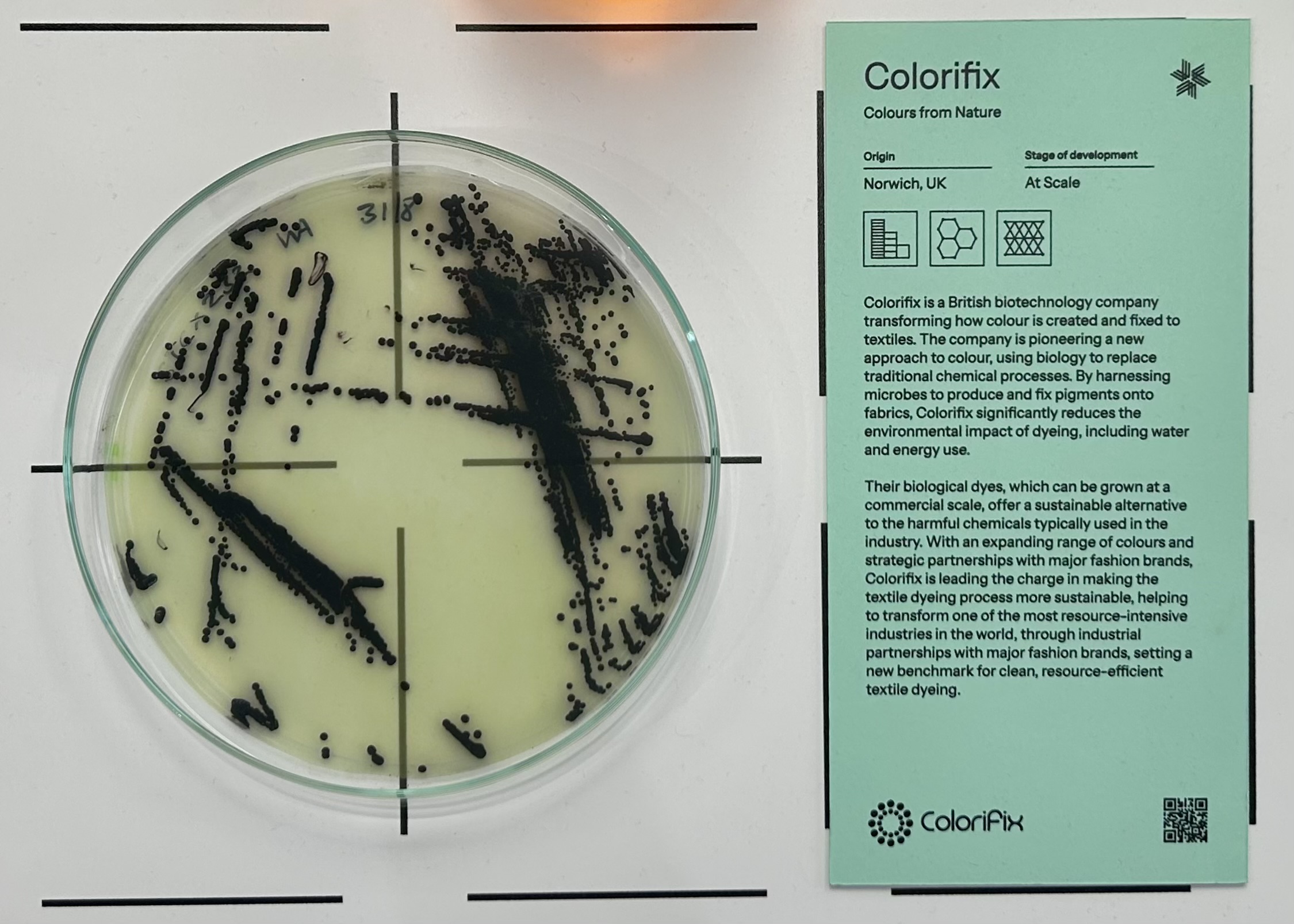
Colorifix is a British biotechnology company that uses microbes, rather than chemicals, to produce and fix pigments in fabric. This process reduces chemical use, as well as water and energy consumption. Because the pigments bind closely to the fibres, the resulting colour is more durable and resistant to wear and washing. I thought this was very cool – it sounds very sci-fi, employing microbes to colour your fabrics, but is actually so simple and effective.
London start-up Tera Mira is prototyping an alternative to elastane made from seaweed, a renewable material that does not require land, fertilisers, or (fresh) water. Conventional elastane is environmentally problematic to produce, and is usually blended with other fibres, making recycling more difficult. Tera Mira’s approach derives polymers from seaweed using a low-temperature, solvent-free wet-spinning process. The resulting fibre is elastic, breathable, easy to dye, and designed for recyclability.
I loved this because I had never considered how seaweed is a crop that doesn’t require land! It would also appeal to students at Arts University Bournemouth because of the costal connection. The presentation itself was also great, particularly the opportunity to see the fibres before they are processed into yarn. They look so delicate on their own, yet come together to make something strong.

Homage to Mountain is currently a concept-stage project that aims to create biodegradable alpine wear inspired by mountain ecosystems. Instead of petroleum-based synthetics, the materials are plant-based, durable, and infused with flavonoids – natural compounds found in alpine flora that provide UV protection and water resistance. I really liked the strong connection between concept, materials, design, and intended use with the alpine theme.


Summary
Everyone agreed that the range of innovations on display was incredible. Like typical librarians, we also appreciated the excellent organisation of the exhibition – each of the four themes had an associated colour, so it was easy to see which materials belonged to each. The display labels also utilised a superb system of symbols to indicate key properties such as bio-fabricated, made from waste, or compostable.
The exhibition runs until 26 June 2026, so there’s still plenty of time to go see it if you couldn’t make the trip!
Thank you to The Mills Fabrica and Viktoria for welcoming us to Fabrica X and their fabulous exhibition.
Central Saint Martins: Materials & Products Collection
The second visit was to Central Saint Martins, a college of the University of the Arts London.
Richenda led the walk to CSM and was a great tour guide. She explained that the Granary Building, which now houses the college, was originally constructed in the 19th century as a grain store. It formed part of a busy industrial hub built around the canal and railway. Since its redevelopment, the area is now a key part of London’s Knowledge Quarter, an innovation district led by academic, cultural, and research institutions.

We had a short tour of the Library, which spans three floors and offers a wide range of specialist resources. These include an A0 scanner, computers dedicated to 3D modelling software, lightboxes, an LED light tent, Cintiq drawing tablets, and even a spray booth. Plus a table set aside for puzzles!
Zoe Buckberry, Assistant Academic Support Librarian: Materials & Products Collection, then welcomed us to the main event: the CSM Materials & Products Collection.
Materials & Products Collection
We began by exploring the display cabinets, which feature special items including student projects and experimental materials. One sample, Bio-invasive Fur by Xue Chen (MA Biodesign), presents a fur alternative made from invasive plant species. In the innovations section of the cabinet is a partially composted bottle by Shellworks, made from Vivomer biopolymer, which shows how significantly it breaks down in just three months in a standard home compost.
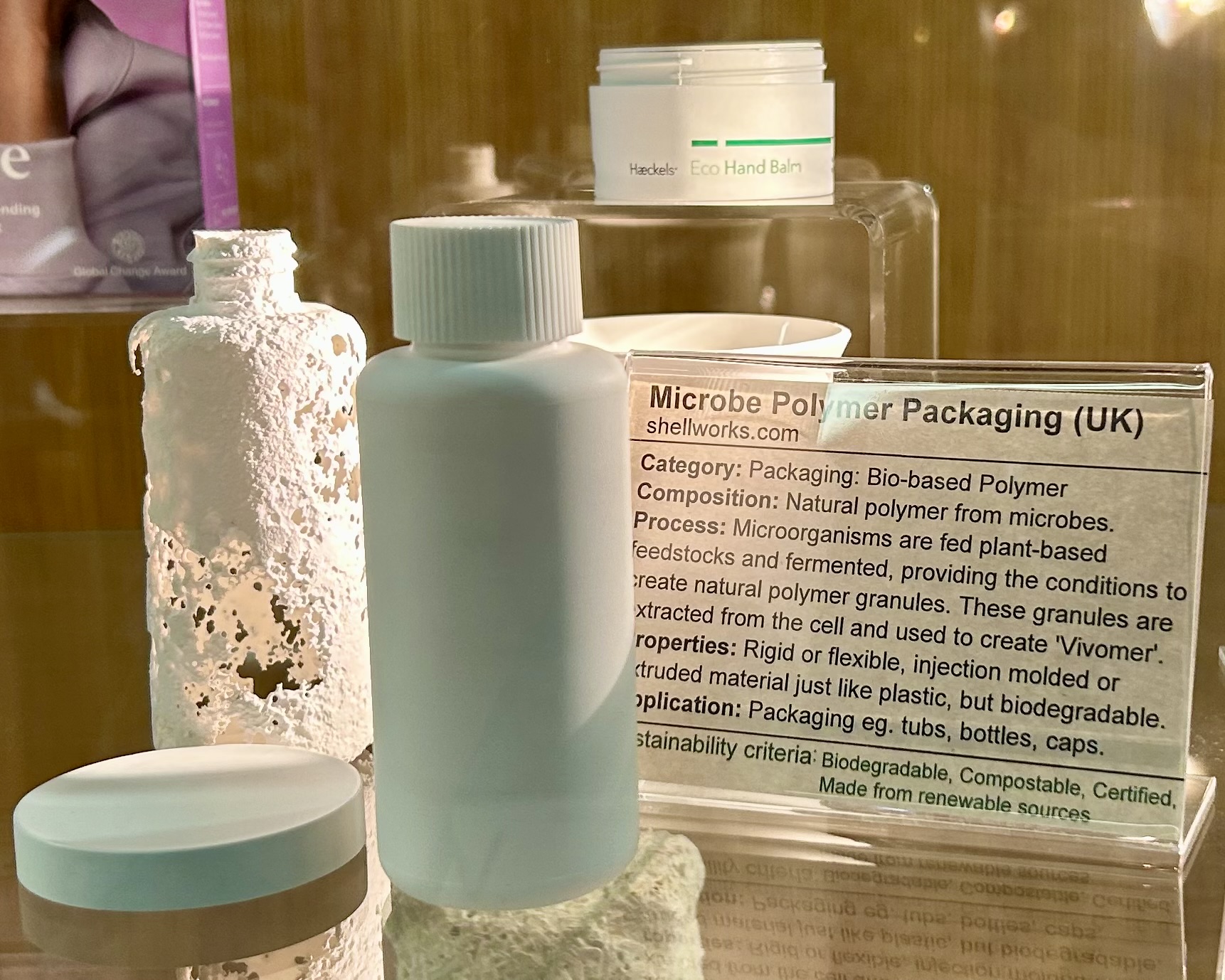
Next to that, a dedicated display highlights sustainable materials that fit with the collection’s sustainability criteria, which students are encouraged to use as a guide to evaluate the impacts of a material or product. It focuses on the inputs, so what it is made from, and outputs, or what happens after use. Each sample is labelled with a green tag indicating which of the Library’s six sustainability criteria it meets: biodegradable, recycled content, recyclable, certified, compostable, and made from renewable sources.

The display features a full spectrum of samples, from plastics to fabrics, and even a has a section just for alternative leathers derived from a wide range of plants: pineapple, apple, mushroom, cactus, bark, palm leaf, olive, tea, and more.
The tea-based leather, Wastea, also featured on the new materials display. It uses Class 4 tea waste, which has a caffeine content too high for use in food production or animal feed. This waste is processed into Bio-PU, forming the upper layer of the material. A suitable base layer is then added depending on the intended application, such as footwear or upholstery. The layers can later be separated and recycled.


We also saw a recent addition: the RE-CD table by Revive, made from 100% recycled CDs and DVDs. The material is formed using only heat and pressure, with each square metre of 10 mm RE-CD repurposing around 1,000 discs.


The rest of the collection is organised by material typology, alongside a large wall of product catalogues. The beautiful GF Smith paper sample stand was also in regular use during our visit, demonstrating the enduring appeal of quality paper across all courses!

We ended with a ‘match the material’ activity. We were given a set of materials and corresponding labels, such as corn and eelgrass. However, the correct matches were not obvious – and in some cases, deceptive – prompting us to handle and even smell the samples to try to identify them. We may not have been very successful, but we learned a lot!
Building materials
The building materials section will be of particular interest to members of ARCLIB.
It includes several innovative construction materials that utilise recycled components, such as composite cladding and recycled plastic lumber from EnviroBuild, and the K-BRIQ, produced from approximately 90% recycled demolition and construction waste.
There are also low-carbon approaches to masonry, such as Hempcrete, a bio-composite made from hemp shiv and a lime binder, and carbon-capturing bricks developed by Earth4Earth, designed to lock atmospheric carbon into the fabric of buildings.
Alongside these innovations are examples of traditional construction techniques. Rammed earth and cob – made from clay-rich soil, straw, and water – demonstrate long-standing, low-impact approaches that are gaining renewed interest in contemporary practice.
However, my favourite samples were the bricks designed to welcome wildlife: the Bee Brick by Green&Blue, made from approximately 75% recycled Cornish china clay waste, and the Bird Brick Box by Schwegler, made from a unique air-permeable wood-concrete. But don’t worry – they’re solid on the inner side, meaning the wildlife won’t be joining you in your home!

Resources
The collection includes a range of books on materials for reference, many of which are also available in the main collection for loan.

The Materials & Products Collection also offers teaching boxes for use in studios. A general box provides a selection of core samples, and Zoe and Billie Coxhead, Materials & Products Co-ordinator, can curate bespoke boxes on request, drawing on a wider range of materials and objects. These teaching boxes feature in the ARLIS/UK & Ireland Research Award Report 2023-4, and one of the resources produced as part of the project is a list of materials and suppliers so you can create your own! You can find this and further materials teaching resources on the project’s Padlet.
Billie and Zoe have their work cut out, since they support all courses and levels of study. They spend time in the collection supporting students and leading materials literacy sessions, balancing this with the behind-the-scenes work required to maintain a collection of this scale.
Even when the space is unstaffed, worksheets and clear signage help students to use the collection effectively.
The best part is: their brilliant LibGuide is open access so you can explore their wide range of resources, including books, journals, materials databases, trade shows, and worksheets: https://arts.ac.libguides.com/Materials/home
Summary
We were all amazed by the extent of the collection, and the degree to which it prioritises and encourages interaction. All of the samples are immediately visible (and touchable!), and the careful organisation makes it easy to explore. We also found the materials labels to be especially useful and informative. It is easy to see why the space is so popular!
Thank you to Zoe, Billie, and Richenda for facilitating a fun and fascinating visit!
Report by: Corin Peacock | Arts University Bournemouth
Leave a Reply