
On Tuesday 10 March, ARCLIB members were delighted to join a virtual visit to The Hive in Worcester, hosted by Dr Stephanie Jones, Library Services Manager.
The Hive is an integrated library service resulting from a long-term collaboration between the University of Worcester and Worcestershire County Council, serving both the academic community of the university and the wider public.
It came about through the happy circumstance that the Council and University wanted the same thing at the same time: a new library. The existing public library – a Grade II listed building – was no longer fit for purpose, while the University of Worcester’s library was insufficient for the institution’s growing student numbers.
The project also addressed an additional problem: Worcestershire’s archival collections were spread across several locations, which made them difficult to access and much less visible than they could be.
A shared facility offered the opportunity to tackle all of these issues together, and thus in 2006, planning began for an integrated library service, and in 2012, The Hive was opened.
Service delivery
The building was delivered through a Private Finance Initiative. Under this arrangement, the Worcester Libraries Trust holds the mortgage and repays it over a 25-year period, during which responsibility for the maintenance of the building remains with the owners. When seven years remain on the contract, the process begins for the council and university to assume full ownership and responsibility for the building.
In terms of space, the building is occupied roughly 70:30 by the council and the university. However, the core library service operates as a fully integrated 50:50 partnership in terms of staffing, stock on the shelves, and service delivery.
For practical reasons, library staff are employed either by the university or by the county council, but their job descriptions and pay are near identical. All staff are managed by Steph, the Library Services Manager, whose role is funded equally by the council and university.
The library is open every day from 8:30 to 22:00. At a minimum, the building is staffed by three customer library advisors and a supervisor, alongside security staff. Because the library has the longest opening hours and is the busiest service in the building, the library team also take responsibility for building management such as monitoring behaviour, safeguarding, and evacuations.
Alongside the integrated library service, The Hive operates through two additional types of partnership. The first is co-located services, which are based within the same building but operate independently and often with different opening hours, such as the Worcester Youth Hub. The other is external working partnerships, where The Hive collaborates with outside organisations to deliver activities and events. For example, Severn Waste Services has run paper-making workshops in the building.
The building
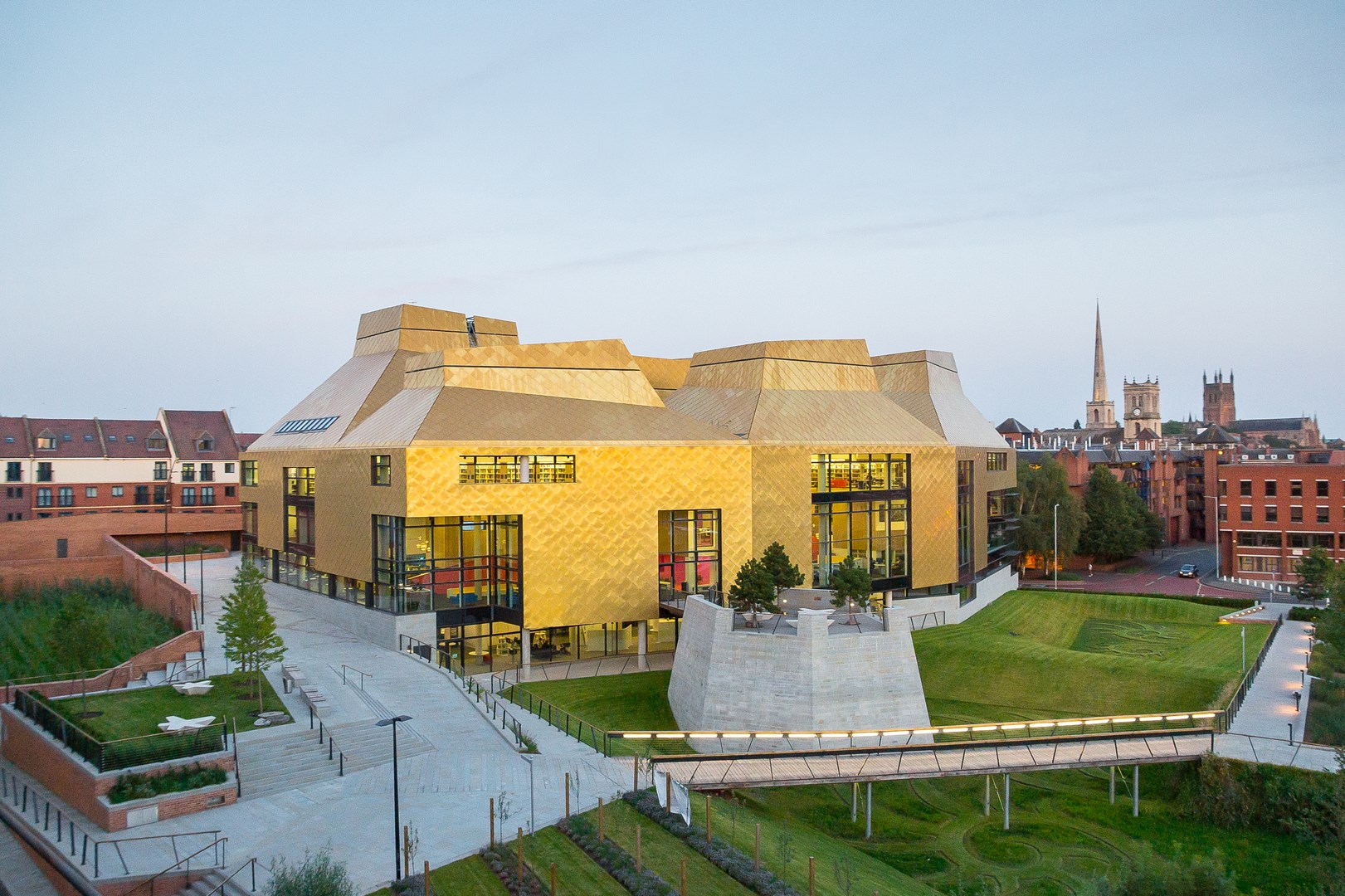
The Hive was designed with a strong emphasis on user experience, atmosphere, and accessibility. The five floors of the building are all fully accessible, and a Changing Places personal care suite is located on the ground floor. Spaces are open to everyone, with no areas reserved exclusively for students.
There is a focus on provision for children as the key demographic of future library users, and as part of the Hive’s aim to support learning inside and outside of the classroom. The children’s library is immediately visible from the ground floor entrance, creating a welcoming environment.
There are baby-changing facilities on every floor and an optional breastfeeding room within the children’s library, although parents are encouraged to breastfeed wherever they feel comfortable. The children’s library also has a room called The Oasis which is used as a meeting space for parents that caters for children, and is used by organisations such as the National Childbirth Trust and Action for Children.
This children’s library also includes a teaching collection, developed by an academic librarian, which provides resources and teaching packs for both students and members of the public.
At the centre of the building is a large atrium that creates an open, flexible space used for exhibitions such as academic outputs, work by the Clent Village Artists, and the annual Worcester Sixth Form art exhibition. The space is also used for events as part of the Hive’s lively cultural programme, including workshops and academic talks. Although many talks are delivered by university lecturers, they are open to everyone.
While sound can travel upwards through the atrium, it does not reach the uppermost floor, Level 4, which is designated silent study space.
The basement level (Level 0) houses seven strong rooms for archives and records. Two of these are climate-controlled to preserve heritage materials, including items such as William Shakespeare’s marriage certificate. Other specialist facilities include a finds room for archaeologists to clean artefacts (and showers for the archaeologists to clean themselves!), digital photography facilities, and a conservation suite.
The Hive even has a Registration Ceremony Suite where weddings, citizenship ceremonies, and other functions take place!
Environmental sustainability was a key element of the building’s design and has resulted in a complex building management system, including:
- a daylight strategy using large windows and seven skylight roof cones
- a biomass boiler
- rainwater harvesting from the roof, used in toilets and the finds room
- automated ventilation that opens and closes windows to manage carbon dioxide levels
- planting of local grasses around the building
One of the building’s most distinctive sustainability features is the river-water heating and cooling system. Water from the nearby River Severn is drawn through an undercroft where it is heated or cooled and circulated through the concrete columns throughout The Hive. The water is then returned to the river at its original temperature.
The building sits so close to the River Severn that it has to be surrounded by flood meadows and can easily become an island when the river rises. Fortunately, The Hive itself hasn’t flooded yet!
Library collections and support
Collections are entirely shared between public and academic users, and all are able to borrow 12 items at a time. Books identified as high-demand items – such as those on university reading lists – are restricted so that members of the public may borrow only one at a time. Increasingly, however, high-demand material is provided through eBooks, so the service is working towards removing this restriction to further democratise access to the collections.
Because both the former university library and public library used Dewey Decimal Classification, integrating the collections was relatively straightforward. However, fiction is arranged simply by author surname rather than by genre, because generifying the existing collections would require too much work.
Students have full access to the university’s electronic resources, while members of the public can access some academic resources, such as JSTOR, when using library computers onsite.
The university’s academic liaison team is based in The Hive but operates outside the integrated staffing model as their work focuses primarily on teaching and academic engagement within university departments. However, they do staff the ‘Ask a Librarian’ service – via email and sometimes face-to-face – which is available to all users. The library’s ‘Study Happy’ programme for wellbeing is also open to everyone, not just university students.
Enquiries can cover an incredibly wide range of topics, from help contacting a tutor to support with homelessness or signposting mental health provision. In-person enquiries to customer library advisors are handled in the same way whether the user is a student or a member of the public, while online enquiries are passed on to the appropriate member of university or council staff. The Hive is particularly proud of their online chat service, with enquiries typically answered within seconds!
Staff at The Hive are trained to take a proactive customer service approach, moving around the building and offering assistance rather than waiting behind a desk. Staff desks are designed for standing use to support this model. Security staff are also trained to act as a welcoming concierge presence at the entrance to the Hive, and to provide basic library support such as with returning books.
Previously everyone used the same printing system, but a change in supplier means there are now separate printers for student and public use. Additionally, while students can borrow equipment such as cameras and laptops through the university, these services are located elsewhere and so are not available to the public.
Evaluation
When the building first opened, some students were concerned about sharing a study environment with members of the public. Over time, however, it has simply become the norm. Many students now appreciate the broader social mix, and the open nature of The Hive means they can meet with local friends, bring their parents for a visit, or study while their children enjoy the library. Encouragingly, Steph reports that their National Student Survey ratings are consistently excellent!
Generally, the building has worked very well. The senior leadership team were involved in the design process, although they mainly focussed on atmosphere and user experience rather than day-to-day practicalities. As a result, storage space can sometimes be limited, and the building now operates with a unthinkably complex arrangement of five Wi-Fi networks: the county council corporate network, the university corporate network, a government network used by Department for Work and Pensions staff, public Wi-Fi, and eduroam. The large windows have also created a lack of wall space for shelving.
Some issues have been easy to mitigate, such as adding more power sockets and reducing the number of fixed desktop computers. Others require ongoing maintenance. For example, scuba divers have to visit annually to clear silt and fish from the undercroft that supports the river-water heating and cooling system.
Overall, The Hive aims to operate with a shared vision, shared priorities, and shared resources, successfully supporting a model of democratised access to education where academic resources, cultural activities, and learning opportunities are available to the whole community.
Many thanks to Steph for hosting such an engaging and informative session!
Report by: Corin Peacock | Arts University Bournemouth
Leave a Reply